Path through the Fog
In my Aliveness Manifesto, I declared that in my “process,” I trust generativity more than closure, and I trust that meaning emerges through making - that I don’t need to know what something is before it begins.
Well, as it turns out, there’s a part of me that does in fact need to know what I’m doing before I do it. There’s a part of me that defaults to trying to make sense of things before they are fully baked. I think it’s part of my wiring. I like to call her my Nerdy Researcher self.
And yet, underneath the Nerdy Researcher, I’ve realized that when I get stressed or agitated, there’s a part of me that seeks nervous-system regulation through organization and control. That’s not a bad thing - it’s actually a win-win for a researcher. But it does create tension with this other part of me that wants to give “aliveness” the space and permission it needs to flow and emerge organically. I feel an essay coming on, about this tension between structure and flow. But for now, I want to share what came out of my effort to calm agitated feelings — my most recent attempts to create a Path through the Fog.
The fog I’m referring to is: What am I actually doing with this Aliveness Experiment? As a social scientist, I need more concrete methods of data collection. I’m afraid I’ll miss something important if I just live my life with the intention of noticing aliveness when it happens. so I crafted two documents to get more intentional about my methods:
An Ontology of Aliveness Current Entry Points: This ontology maps different “currents” of aliveness—embodied, generative, relational, communal, ecological, imaginal, and collective/systemic—as ways life force becomes perceptible in lived experience. Each current can be encountered in everyday moments, intentional containers, interactive participation with others, or emergent situations where something new comes into being. The map is not a prescription or productivity tool, but an orienting frame: a way to notice where aliveness is already moving, to diversify access points, and to support aliveness in recognizing itself while living. (for my Nerdy Researcher friends, click the link above to read the document).
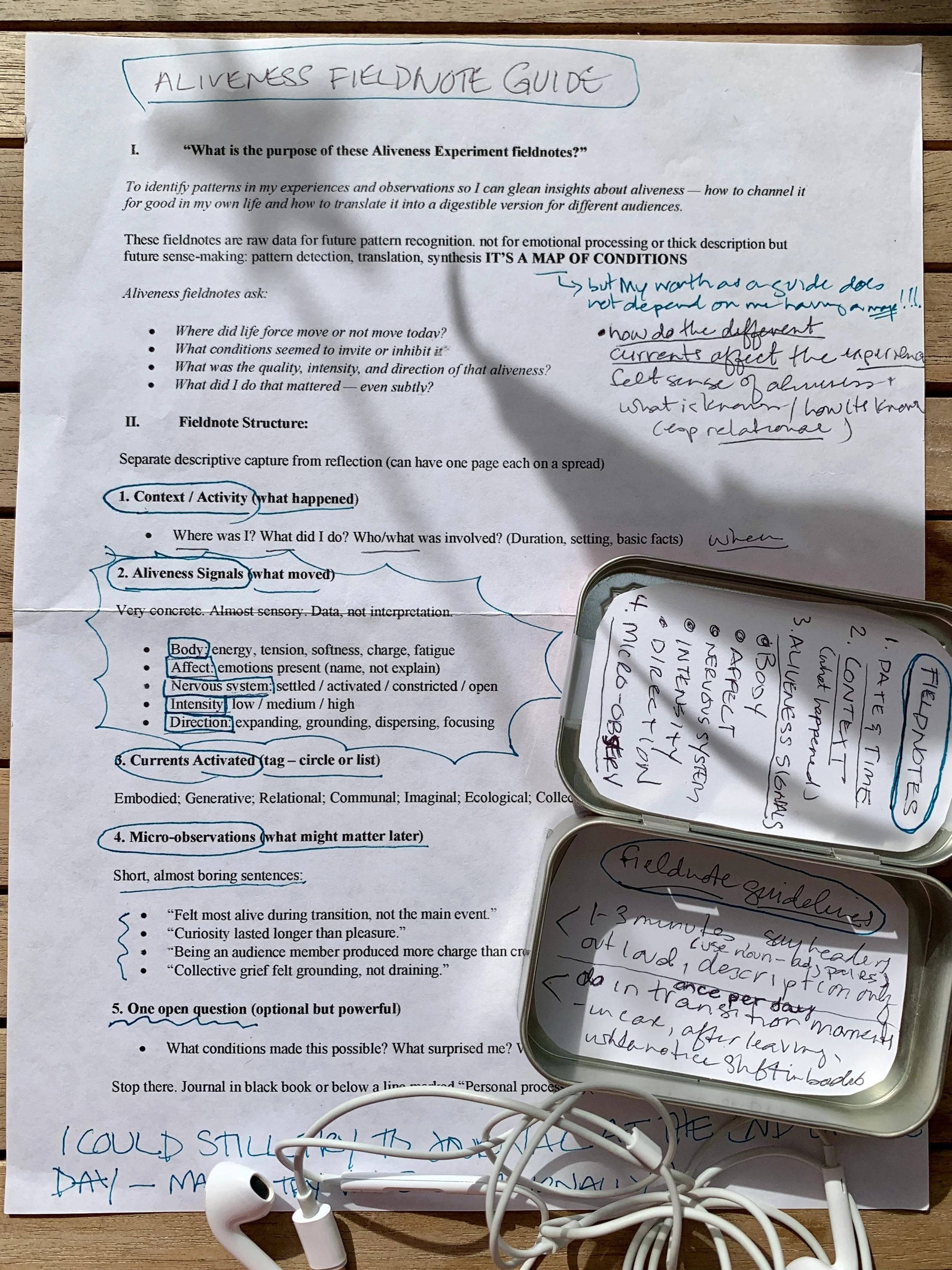
An Aliveness Fieldnote Guide: This guide aims to provide a structure for capturing raw data in my experiences of aliveness, so I can identify patterns and glean insights. My thought was to capture voice notes during or immediately after seemingly significant encounters with aliveness (or lack thereof), which would track aliveness signals (sensory data) observed in body, affect, nervous system, intensity, and direction; tag what aliveness currents were activated; make micro-observations; and possibly take up an open question like: What conditions made this possible? What surprised me? What didn’t fit my assumptions?
After I drafted these documents, I realized that the structure was getting in the way of actually living aliveness, that the reason phenomenological studies work is because the experience comes first and the meaning-making comes second. Still, it was a helpful process to think through these issues.
For now, I’m letting these documents rest where they belong: not as instructions for how to conduct my Aliveness Experiment (or for how to live, for that matter), but as artifacts of a point in my process. This may not be the path out of the fog, exactly—but it is a record of how I tried to listen while I was in it. And for now, that feels like enough.