Edges: An Exploratory Essay
On this particular walk to the lake, I was on edge: that familiar, unpleasant state of agitation without a source, the feeling that something is off but not yet nameable. I sensed, vaguely, that grief was somewhere below the surface, but I couldn’t reach it directly. I just needed to move.
I typically take a few photos on these lake walks – what I call my Nature Report. It’s a small ritual of attention, mostly for my own practice and appreciation, which I share privately, then archive publicly. But this day, as my footfalls thudded on the paved bicycle path, a sharp refusal rose up: no photos. Just grief. Just anger, too—not directed, but present. I didn’t want anything to interfere with my effort to move these emotions.
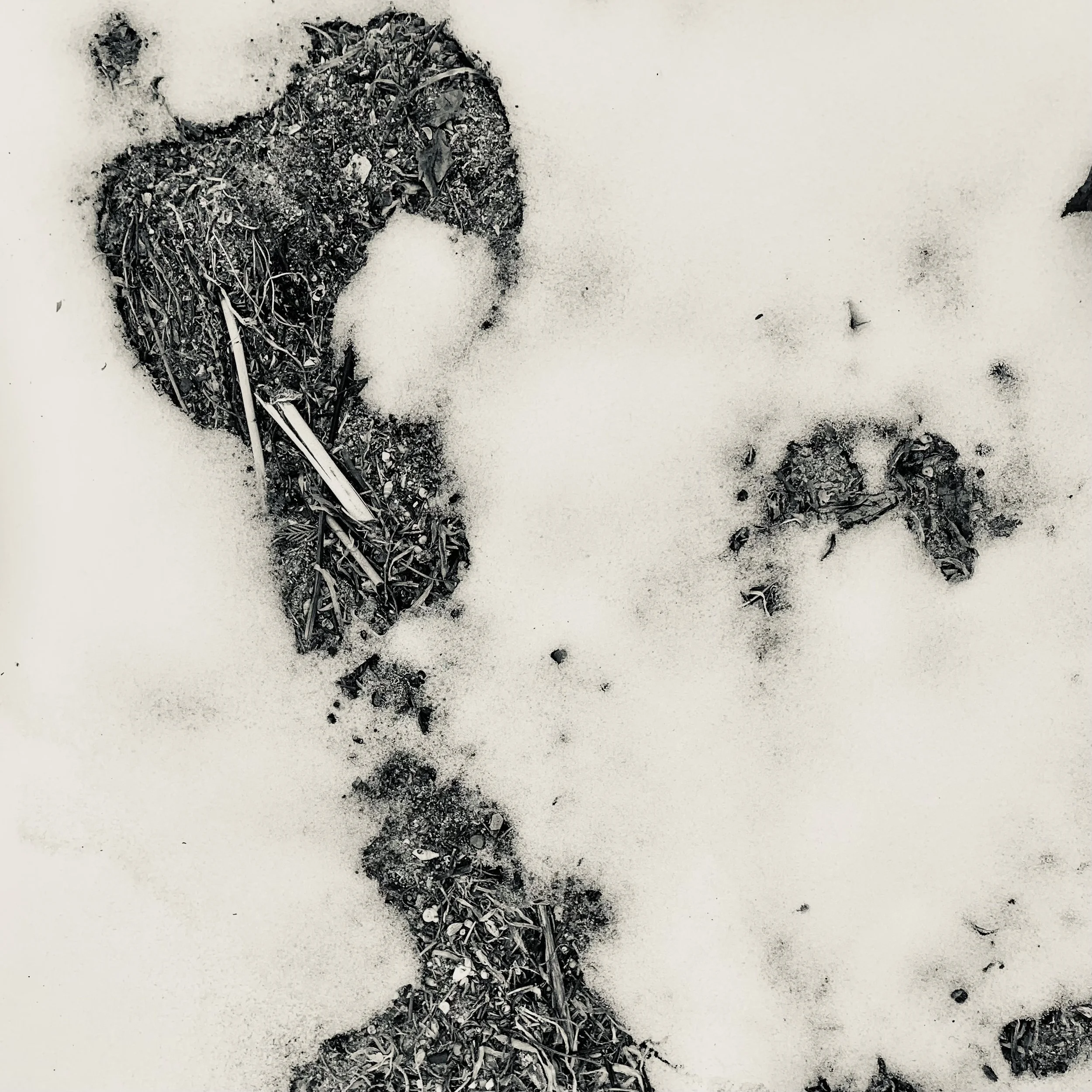
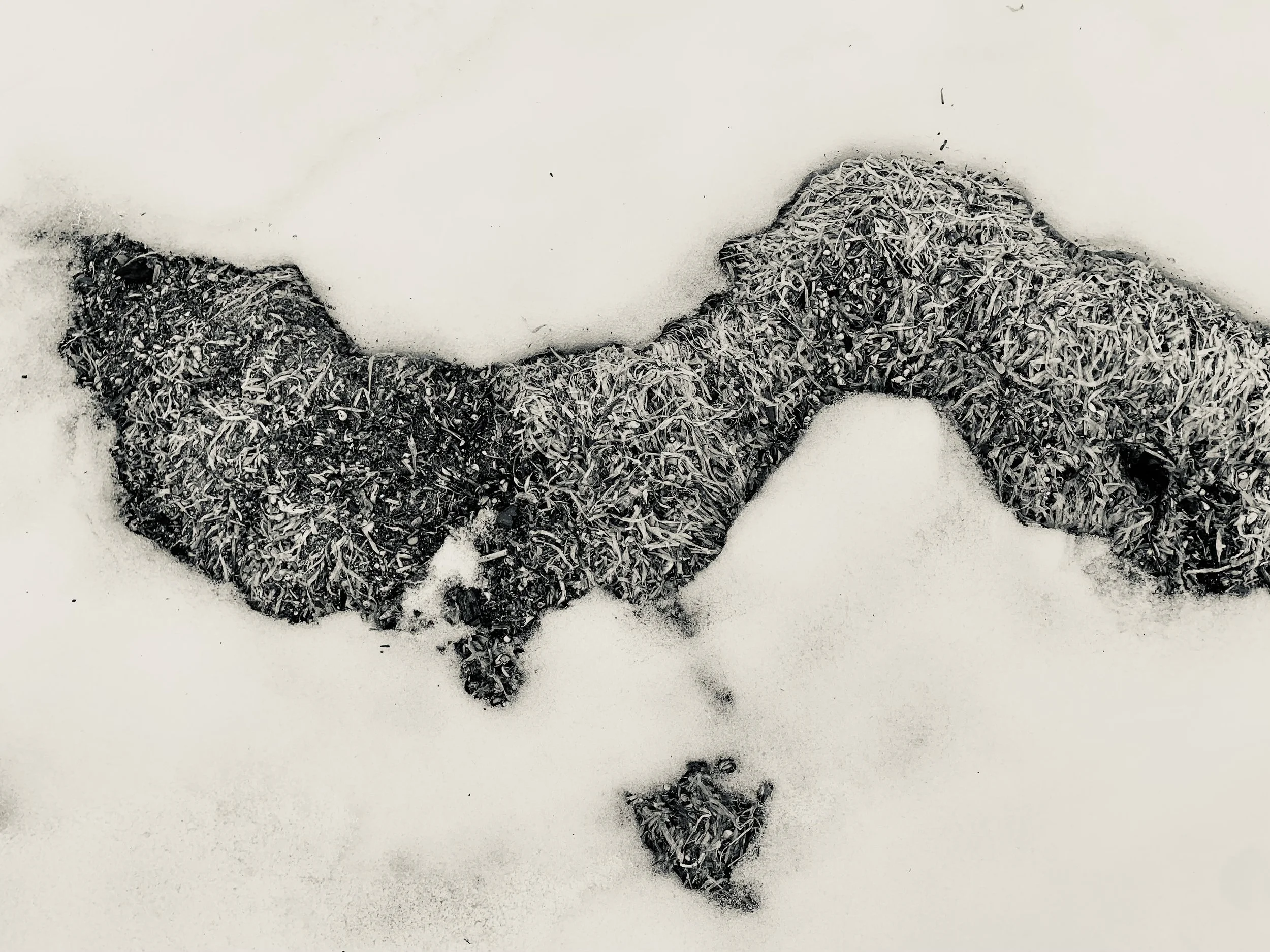
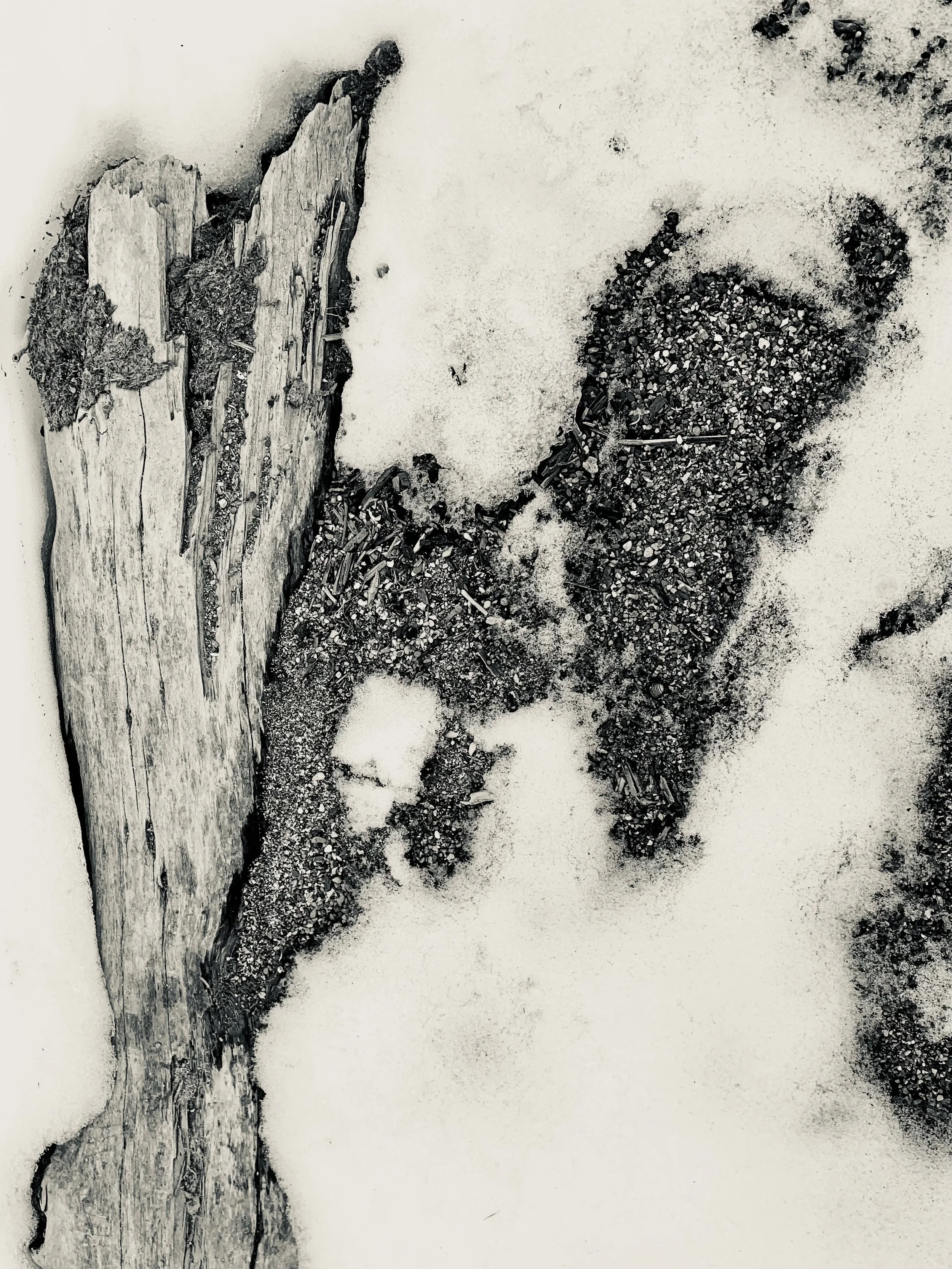
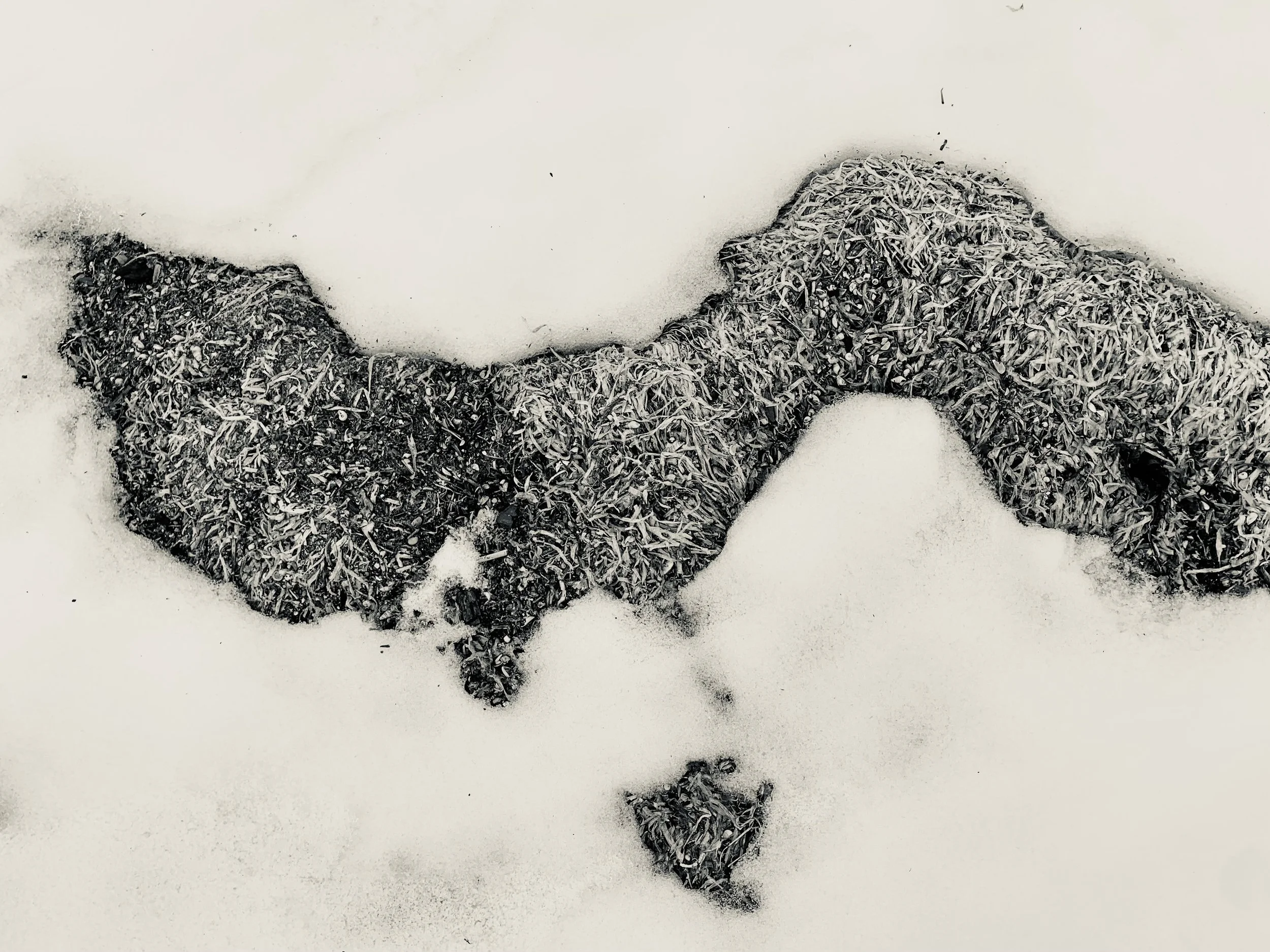
Yet as I approached the beach, I heard a single word in my head: Edges. When I looked around, I saw edges everywhere.
The white blanket of snow and ice I had come to expect at the lake was now melting unevenly, thinning to reveal what lay beneath. Snow gave way to grass; grass, to sand. Lines of debris marked where waves had once reached before winter froze them in place. My attention absorbed, I found myself photographing only those places – where one thing ended and another began. It felt significant, almost compulsive. Everything else fell away as I framed edges in my viewfinder.
“Edges” stayed with me for days. I knew I had to reflect and write more deeply. Why wouldn’t this idea move on or let me go?
A conversation with my closest confidant brought up the psychology of perception. It turns out that human vision is especially sensitive to edges. In neuroscience, researchers have found that many neurons in the visual cortex fire most strongly not at surfaces or centers, but at boundaries, places of contrast and change. A field of uniform snow is low information – low value. But snow stopping at defined lines of yellowed grass wakes the eye, sending a message to the brain that something important might be happening.
Gestalt psychology takes this further: edges are what allow a figure to emerge from its background at all. Without contrast, without boundary, nothing stands out. Meaning itself depends on edges.
This helped explain my visual fixation at the lakeside. But what about my grief and anger? What did edges have to do with the emotions I was feeling?
As a regular practice, I turn to journaling to metabolize experience and suss out meaning. Soon I was filling pages with one question: why edges? What could this word be signaling?
I began with the most concrete, obvious meaning: An edge is a boundary—the place where one thing ends and another begins. This is what I responded to visually and viscerally on the beach: snow breaking into grass, grass stopping at sand, debris marking the reach of water long since frozen. These were places of transition, not fully one thing or another.
Edges can also be emotional; that is, tonal, not just spatial. To be “on edge” is to feel sharpened, reactive, alert. It’s intensity before clarity, when something is present but has not yet taken shape. Agitation gripped me that day without a known source – the strident, internal “no photos” command. Grief and anger burned in my chest, my throat, behind my eyes; they had no object, no story yet. Still, they had a distinct outline – perhaps vague in language terms, but otherwise sharp.
These emotional edges were unquestionably alive in my body. And like all the other times I’ve experienced strong, “negative” emotions, I wanted to get past them. Now, I’m beginning to notice how often we treat such states as problems to solve. We aim to calm down, figure it out, move through. In doing so, we often choose relief over realness. Yet I wonder now what it would be like to stay with the real feelings a little longer, to hold space for them and accept them as they are. To accept myself, as I am, in the midst of intense feelings.
The third kind of edge I’ve been exploring is experiential: the edge as threshold. The moment before crossing. The pause before a decision. A relationship before it is defined. Spending time at this edge can feel like indecision or paralysis, but it’s really about nearness and difference – where multiple futures are still possible.
This in-between space can be acutely uncomfortable. It’s highly sensitive, unstable, and tempting to escape. Sometimes not crossing is informed by consideration and care. Sometimes it’s shaped by fear, triggered by past experience and imagined consequences. I am trying to tell the difference, but it’s not easy. What I know is that the urge to resolve—to decide, explain, or finalize—is often strongest right here.
Dr. Suess called it The Waiting Place:
You will come to a place where the streets are not marked.
Some windows are lighted. But mostly they’re darked.
A place you could sprain both your elbow and chin!
Do you dare to stay out? Do you dare to go in?
How much can you lose? How much can you win?
And IF you go in, should you turn left or right…
or right-and-three-quarters? Or, maybe, not quite?
Or go around back and sneak in from behind?
Simple it’s not, I’m afraid you will find,
for a mind-maker-upper to make up his mind.
He labeled it “a useless place,” where everyone is just waiting — waiting for a train to come, a bus to go, the phone to ring, the snow to snow. But I wonder if something else is happening there. Oh, the Places You’ll Go! is, after all, about movement. The Waiting Place is not an endpoint but a liminal zone — a place we inhabit on our way, before we cross the threshold, before the transition is complete.
It helps me to know that this kind of edge actually exists in nature. In ecology, the space between two habitats – the ecotone, or edge – is not merely a dividing line but a zone with its own conditions. Neither forest nor field, meadow or mountain, this in-between space often supports greater biodiversity than either. The edge is not lacking. It is generative.
When I look back at the visual edges on the beach, the emotional edges I was carrying, and the experiential edges I am navigating now, a pattern emerges. At edges, I feel most alert to what is happening and most tempted to make it stop. Relief is fast. Resolution is rewarded. Truth, however, often arrives more slowly, and messily.
Carl Jung believed that something new can emerge when we resist the urge to collapse tension too quickly. Holding this tension between opposing or differing possibilities can be excruciatingly, almost intolerably uncomfortable. But I’m curious enough about the creative potential to try.
I wonder: what if discomfort is not always a signal to move away, but a potential sign that something important is taking shape? Can we relate what we know about visual perception of edges to experiential edges?
I don’t know the answer yet. For now, I am practicing staying present with what’s transitioning, without forcing it to finish before its time.
I like to think I’m at the edge of a future I could never have imagined without the experience.